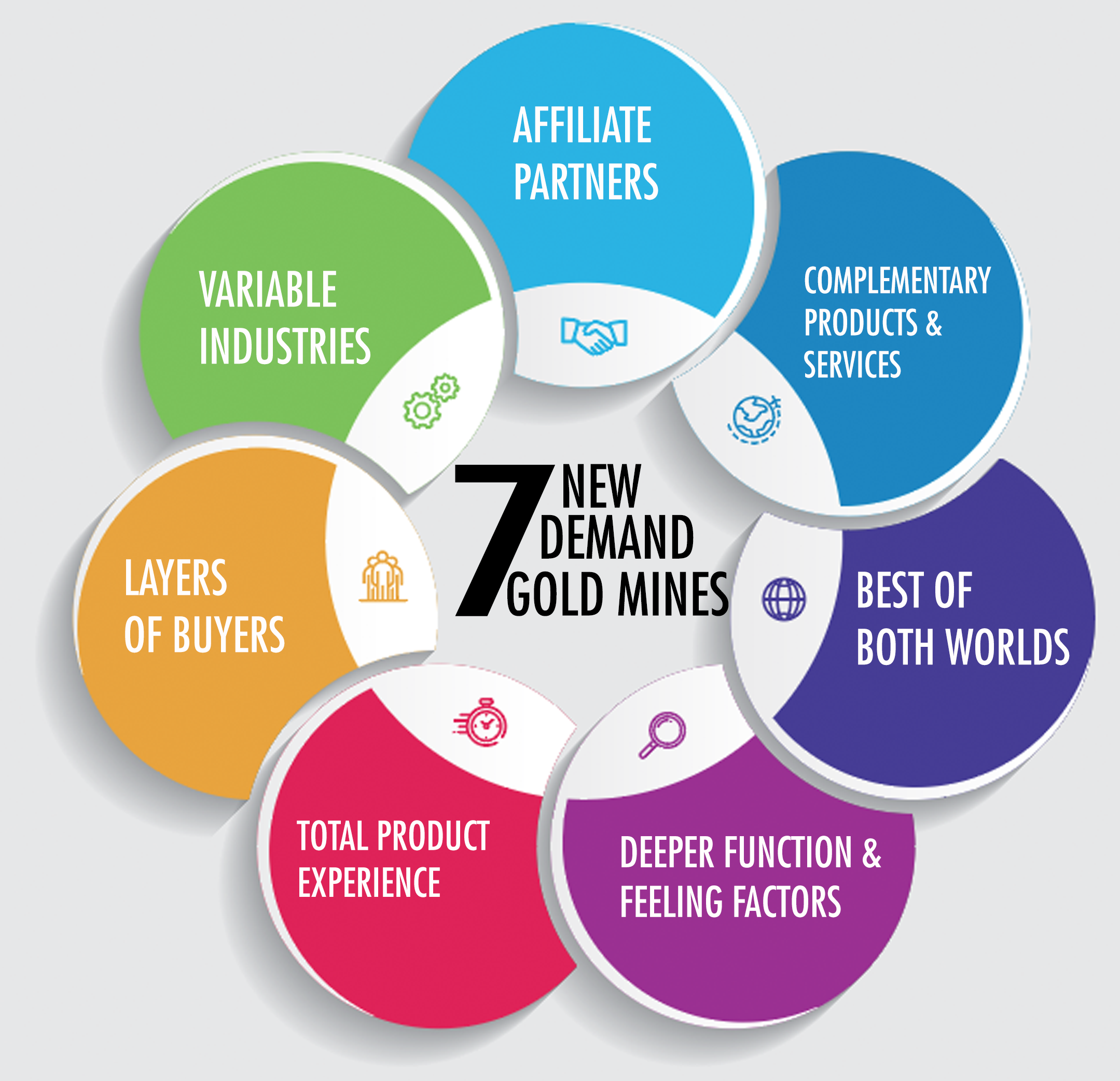
Goldmine 01
Affiliate Partners
Someone else already serves the people you want to help.
Look beyond your competitors to businesses in other industries that share your customers. What do those customers need before, during, or after working with you? A complementary partner may help you reach them, solve more of their problem, or handle part of the delivery with the right training. The opportunity isn't simply exchanging referrals. It's finding a useful connection that creates value for the customer and makes sense for both businesses.
Who already has a relationship with your customers—and could help you serve them better?
Goldmine 02
Complementary Products & Services
Your offering may solve only part of the customer's problem.
Consider the products, services, or features your customers naturally want alongside what you provide. Could a thoughtful addition or bundle make their experience more complete? This isn't about adding more stuff or copying a competitor's package. Start with what the customer actually wants, then consider whether a complementary offering removes an inconvenience, fills a gap, or makes the original purchase more useful.
What do your customers still have to find somewhere else after buying from you?
Goldmine 03
Best of Both Worlds
What if the customer didn't have to choose?
Sometimes demand hides between two things people want but assume they can't have together. In the blueprint, I use exercise and learning to cook healthy food as one example: two related desires that could be brought into one business experience. The same thinking applies to a product that works on both beach sand and the highway. Look for the trade-offs people accept, then ask whether there is a meaningful way to combine the benefits rather than make them choose.
Which two benefits would your customers love to have together?
Goldmine 04
Deeper Function & Feeling Factors
The practical purchase is only part of the story.
Customers bring fears, worries, pressures, and priorities that may never appear in your list of product features. Look beneath the obvious reason for buying. What would help someone feel more confident, secure, or supported? A deeper concern may sit outside the normal distinctions your industry competes on. Understanding it can reveal a more useful way to serve the person—not just improve the product specification.
What is your customer worried about that your industry rarely addresses?
Goldmine 05
Total Product Experience
The experience starts before the sale and continues after delivery.
Follow the customer's whole journey: recognizing a problem, searching for a solution, finding you, buying, using the product or service, ending its use, sharing the experience, and returning. Their needs and priorities change along the way. A business can deliver its core service well and still miss important moments around it. Look for the unanswered question, unnecessary friction, or missing support that could make the entire experience more valuable.
Where in the full customer journey are people still left to figure things out alone?
Goldmine 06
Layers of Buyers
The person paying may not be the person using—or influencing—the purchase.
One purchase can involve several people with different concerns. An owner may want to save money, a manager may need greater productivity, and the user may need a tool they can use effectively and confidently. An influencer can shape the decision without signing the check, and that role can shift. Examine each perspective rather than treating the buyer as one person with one priority. Demand may be hiding in the needs of someone your offer or message barely acknowledges.
Whose concerns are being missed between the decision-maker, the influencer, and the user?
Goldmine 07
Variable Industries
Your experience may have value beyond the market you're in now.
The boundary of your current industry isn't necessarily the boundary of your opportunity. Consider direct, indirect, or related markets where your knowledge, product, or approach could solve a useful problem. This also means questioning whether you're staying with a direction because it fits—or because you've already invested so much in it. A solution you've developed inside your own business might help others in the industry through advice or a different offering. The point isn't to abandon what works. It's to see where else that value belongs.
Where else could something you've already learned or solved be genuinely useful?